Showing posts with label beatles mystery. Show all posts

Sunday, February 17, 2013

Legend: Walrus


 Please see the Introduction To Rabbit Hole Legend A-Z post for information about sources and purpose

Walrus: "I am the Walrus" ("No You're Not!" said little Nicola). The Walrus was Paul. If it's not Paul in the walrus costume in George Harrison's "When we was Fab", then who is it? What's up with all the smoke and mirrors around the walrus??

I would like to note here that I spent a great deal of time trying to verify the "Paul is Dead" rumor regarding "Walrus means corpse in Greek" or "Walrus means death in Scandinavian countries".  I searched for hours and hours, and through multiple books. I have Failed to find any evidence of Walrus being related to Greek anything, and the Greek name for walrus translates into "Tooth-walker". The Scandinavian rumor was harder, I couldn't find a direct relationship between Walrus and any terms meaning death; BUT! Read on....

"Both in Chukotka and Alaska, the aurora borealis is believed to be a special world inhabited by those who died by violence, the changing rays representing deceased souls playing ball with a walrus head.

Because of its distinctive appearance, great bulk, and immediately recognizable whiskers and tusks, the walrus also appears in the popular cultures of peoples with little direct experience with the animal, particularly in English children's literature. Perhaps its best-known appearance is in Lewis Carroll's whimsical poem "The Walrus and the Carpenter" that appears in his 1871 book Through the Looking-Glass. In the poem, the eponymous antiheroes use trickery to consume a great number of oysters.[...]

Another appearance of the walrus in literature is in the story "The White Seal" in Rudyard Kipling's The Jungle Book, where it is the "old Sea Vitch—the big, ugly, bloated, pimpled, fat-necked, long-tusked walrus of the North Pacific, who has no manners except when he is asleep". <Source>

"Walruses have their part in Inuit mythology. In one of the stories explaining the northern lights, the flickering patterns in the sky are thought to represent people who have died and travelled to the other world, where they engage in a game of soccer or football. As they dance across the sky, the sky-players use a walrus head as a ball, kicking it back and forth. If they kick it just right, the tusks get stuck in the snow and the head stands still. 

Another legend, the story of Arnakpaktuq or Arnaqtatuuq, tells how a shaman decided to be reborn as many different species of animals, in order to find out how they lived. At one point he lived as a walrus. He said that the walruses were friendly and pleasant to live with, except that they kissed a lot and their kiss (perhaps used to suck molluscs off the bottom of the ocean) was very powerful.

A third myth, widespread across the whole Arctic, tells of how walruses were created from the third finger joints of Sedna, when her father cut them off." <Source>

  Other notable Walrus associations: "Barry White, who was popularly known as 'The Walrus of Love'.  Supermarine Walrus- a British amphibious aircraft of World War II, Westland Walrus- a British reconnaissance aircraft of the 1920s, HNLMS Walrus- two submarines of the Royal Netherlands Navy,
HMS Walrus- the name of two ships and one submarine of the Royal Navy, SS Walrus- a 19th century vessel that operated in Australia as a floating, illegal, moonshine still, before being replaced by the legal, Beenleigh Rum Distillery, USS Walrus- three submarines of the United States Navy, Walrus class submarine- a type of submarine currently operated by the Royal Netherlands Navy." As well, "The Walrus is a Canada general interest magazine; Walrus (comics) is a minor Marvel Comics supervillain of Spider-Man." <Source>  


AND...then there is this: [From: The Lion, the Witch and the Walrus Images of the Sorcerous North in the 16th  and 17th centuries, Stefan Donecker (European University Institute, Florence)]

"In the 15th century legendary Saga of Hjálmþér and Ölver (Hjálmþés saga ok Ölvers), the two heroes and their companion, Hörðr, flee the wrath of evil King Hundingr. In a feat of amazing saga shapeshifting, the king transforms himself into a walrus and pursues the heroes' ship:

A little while after, they saw a great walrus making for them, angry and frightful to behold. “There”, said Hörðr, “is a creature very ill-disposed towards me, that I may not look upon. [...] You must not name my name while he is here, for if you do I shall die.” And he lay down in the hold, and they covered him with clothes.

[...] Despite his untimely demise, Hunding the walrus is a worthy representative of the many strange beasts and creatures that were believed to dwell in the north.[...]

Both in the Historia de gentibus septentrionalibus as well as in his famous map of the north, Carta Marina (1539), Olaus describes and visualizes a vast array of fearsome animals that dwell in the north, on land and in the sea, many of which are said to prey on hapless human beings. Again, the mighty walrus is not missing, and it is described as a particularly dangerous creature:


The Norway Coast, toward the more Northern parts, hath huge great Fish as big as Elephants, which are called Morsi, or Rosmari, may be they are so from their sharp biting; for if they see any man on the Sea-shore, and can catch him, they come suddenly upon hum, and rend him with their Teeth, that they will kill him in a trice. Therefore, these Fish called Rosmari, or Morsi, have heads fashioned like to an Oxes, and a hairy Skin, and hair growing as thick as straw or corn-reeds, that lye loose very largely. They will raise themselves with their Teeth as by Ladders to the very tops of Rocks, that they may feed on the Dewie Grasse, or fresh Water, and role themselves in it, and then go to the Sea again.

Vicki Ellen Szabo has pointed out that Olaus' impressive accounts of walruses, whales and similar sea monsters were deeply rooted in medieval traditions that perceived such creatures not only as symbols of evil and paganism, but even as factual agents and associates of the devil. The archetype of all such infernal maritime monsters was the biblical Leviathan, which was commonly equated with the great fish that had swallowed Jonah, and whose gaping mouth came to signify the entrance to hell." <Source>


Saturday, February 16, 2013

Legend: Shoes

 Please see the Introduction To Rabbit Hole Legend A-Z post for information about sources and purpose

 (Please note that this video is not an actual Paul McCartney video, I believe it is from the Iamaphoney studios. However, below I have the origins of this song)

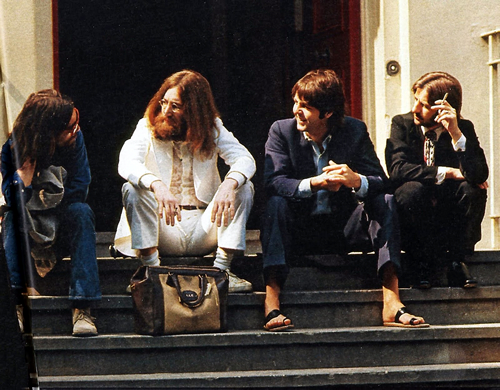
Shoes (or the lack thereof): Shoes are where it all began, to some degree. According to "basic mythology" around the Paul is Dead hypothesis, and how it came to be is that fans noticed it, was that on the Abbey Road album Paul was dressed nicely, but was not wearing shoes. All the others were. This struck up a fervor because supposedly people were buried without shoes and barefoot is a sign of death for the mafia. By then people notice Paul isn't wearing his shoes during I Am The Walrus, in Magical Mystery Tour- they are laid by the drums, and on the album booklet, they look bloody.

Paul also later recorded a very strange song called Shoes. Shoes are kind of a big part of the PID story, and we'll examine the story behind the Abbey Road shoes more in a later post. 

I'll also note here the line in George Harrison's song, Beware of Darkness, "beware the soft shoe shuffler". There is also the line from John Lennon's Serve Yourself, "You're lucky to have a damned pair of shoes!" and the line from his song Crippled inside, "you can shine you're shoes/and wear a suit/you can comb your hair/and look/quite cute/you can hide your face/behind a smile/one thing you can't hide/is when you're crippled inside". John does a cover of Blue Suede Shoes, George does a cover of Old Brown Shoe.

I was unable to find any link between mafia meanings of barefoot, and I determined that people in Europe were sometimes buried without shoes, but this wasn't always the case, and you can find examples of antique burial slippers. 

 {I'd like to note here that the Abbey Road album cover used to make me think of a pilgrimage when I'd idly see the image somewhere, not knowing any of the mythology around it.}

"Never wear anything new to a funeral, especially shoes." <Source: Victorian funeral customs, fears and superstitions>

"At their most basic level, shoes represent human frailty.[...] In the western world, shoes were often associated with good luck and safe travel. The tradition of throwing old shoes at ships insured a sailor’s safe return and continues in the form of tying shoes to the Newlywed getaway car." <Source>

"Shoes in symbolism have a contradictory significance. They represent authority and power, but they can also represent humility, servitude. It all depends on the context we find them in. [...] In older times, not all people could afford buying shoes (slaves often didn't wear shoes), that is why they are associated with wealth, freedom and comfort, but also with the other side of the coin: vanity and arrogance.[...] Shoes keep our feet warm and protected,so obviously, for some individuals shoes symbolize protection or an environment where one can feel safe.[...] 

In gravestone symbolism, empty shoes symbolize the loss of a child. Usually one shoe is overturned. Thus shoes represent human frailty." <Source>

"In the Holy Bible's Old Testament, the shoe is used to symbolize something that is worthless or of little value. In the New Testament, the act of removing one's shoes symbolizes servitude. The Semites regarded the act of removing their shoes as a mark of reverence when approaching a sacred person or place. In the Book of Exodus, Moses was instructed to remove his shoes before approaching the burning bush:

“ Put off thy shoes from off thy feet, for the place whereon thou standest [is] holy ground (Exodus 3:5). ”

The removal of the shoe also symbolizes the act of giving up a legal right. In Hebrew custom, the widow removed the shoe of her late husband's brother to symbolize that he had abandoned his duty. In Arab custom, the removal of one's shoe also symbolized the dissolution of marriage.[...]


Empty shoes may also symbolize death. In Greek culture, empty shoes are the equivalent of the American funeral wreath. For example, empty shoes placed outside of a Greek home would tell others that the family's son has died in battle." <Source>

Barefoot: "[From Masonic Knowledge site, see source] From In the first three degrees, the candidate is asked to become barefoot. Why is this?

Barefoot have several meanings. For example, nakedness of feet is a sign of mourning. God says to Ezekiel, the priest (Ezekiel 24:17) “Make no mourning for the dead......and put on thy shoes upon thy feet.” David is said to have gone from Jerusalem barefoot, when he fled from Absalom. It is also a mark of respect. In the Koran we find the passage “Surely I am your Lord, therefore put off your shoes......." (Ta Ha 20:12). Muslims do indeed leave their shoes at the door of a mosque before entering. In Christianity we find that Moses took off his shoes to approach the burning bush where the angel of the Lord called to Moses (Exodus 3:5); priests serving in the Tabernacle (a tent sanctuary used by the Israelites during the Exodus) did so with their feet naked, as they did afterwards in the Temple. This is likely what is referred to in our rituals.

The foot is said to represent the soul, as it serves to support the entire body and keep it upright. Demonic beings, for this reason, were often depicted with feet that differed to those of man, or were turned the wrong way. [...]

One direction Pythagoras gave to his disciples was "Offer sacrifice and worship with thy shoes off." Maimonides, the great expounder of the Jewish Law, asserts that "it was not lawful for a man to come into the mountain of God's house with his shoes on his feet, or with his staff, or in his working garments, or with dust on his feet." The Druids also practiced this by performing their rites barefooted, as did the Peruvians before they entered the temple to worship the Sun." <Source>
 

" There are times in Jewish life when the wearing of shoes is forbidden.[...] There is also a custom amongst certain chassidic groups to remove their (leather) shoes before approaching the gravesite of a holy person. This tradition goes back to the command to Moses when he approached the Burning Bush (Exodus 3:5), "Remove your shoes from your feet, for the place on which you stand is holy ground. On the historic day of mourning, Tisha b'Av, Jews are prohibited from wearing leather shoes. The same prohibition applies on Yom Kippur to show remorse and penance.

In the Book of Isaiah (20:2), Isaiah is commanded to remove his sandals as a sign of mourning. Shoes also play a part in the mourning period after a death. During the period of shiva, the seven days of mourning, leather shoes may not be worn. In Talmudic times, both the pall bearers and the mourners went barefoot." <Source>

"To go barefoot was a sign of great distress (Isa. 20:2, 3, 4), or of some great calamity having fallen on a person (2 Sam. 15:30). [...] 

The word [barefoot] is found in the following passages: English Versions of the Bible, "He went barefoot" (2 Sam 15:30); "(Isaiah) did so, walking .... barefoot" (Isa 20:2); and like the Egyptians, "naked and barefoot" (Isa 20:3,4). It seems that David in his flight before Absalom "went barefoot," not to facilitate his flight, but to show his grief (2 Sam 15:30), and that Micah (1:8) makes "going barefoot" a sign of mourning [...]. The nakedness and bare feet of the prophet Isaiah (20:2) may have been intended to symbolize and express sympathy for the forlorn condition of captives [...].

Jastrow [...] presents a view worth considering of going barefoot as a sign of mourning and then of grief in general [...]. All these passages seem to imply the discomfort or going barefoot on long journeys, over stony roads or hot sands; but then, as now, in the Orient sandals seem to have been little worn ordinarily in and around the house." <Source>


"Many people in ancient times, such as the Egyptians, Hindus and Greeks, saw little need for footwear and, most of the time, preferred being barefoot. [...] The ancient Greeks largely viewed footwear as self-indulgent, unaesthetic and unnecessary. Shoes were primarily worn in the theater as a means of increasing stature, and many preferred to go barefoot.[...]

 Bare feet have also come to symbolize innocence or childhood, and this may be one reason why hippies often went barefoot during the counterculture movement of the 1960s.[...]

  It is also customary in Judaism and some Christian denominations to go barefoot while mourning. Some Christian churches practice barefoot pilgrimage traditions.[...]

It was an integral part of most slave laws ("slave codes") to mandate that slaves have to go barefoot as a matter of course. For example, the Cape Town slave code states that, "Slaves must go barefoot and must carry passes." This was also seen in states that abolished slavery later in history, such as Brazil, as most images from the slavery period suggest that slaves were barefoot. In Zimbabwe, prisoners must be barefoot as well. Shoes have been considered as badges of freedom since biblical time." <Source>


Sunday, February 10, 2013

Legend: Moondog

Please see the Introduction To Rabbit Hole Legend A-Z post for information about sources and purpose.
Moondog: Moondog has an old association with the Beatles, being one of their earliest names (Johnny and the Moondogs). Also, the lyric in, I Dig a Pony, "I pick a moon dog/Well you can radiate everything you are/Yes you can radiate everything you are/ Oh now".


 At 2:45 in this video, during The Kennedy Awards televised program, Alec Baldwin is giving a speech about Paul and says, "Paul, we honor you tonight for your career as a Beatle, the leader of Wings, and incredible solo performer, creator of our favorite songs, and, yes...as a Moon dog, too." Paul is wearing a Rainbow-coloured ribbon lanyard around his black suit lapel, looking like a moondog'd moon.


 "A moon dog, moondog, or mock moon,is a relatively rare bright circular spot on a lunar halo caused by the refraction of moonlight by hexagonal-plate-shaped ice crystals in cirrus or cirrostratus clouds. Moondogs appear 22° to the left and right of the moon. They are exactly analogous to sun dogs, but are rarer because to be produced the moon must be bright and therefore full or nearly full. Moondogs show little color to the unaided eye because their light is not bright enough to activate the cone cells of humans' eyes." <Source>

"Moon Ring Weather Folklore: Folklore has it that a ring around the moon signifies bad weather is coming, and in many cases this may be true. So how can rings around the moon be a predictor of weather to come? The ice crystals that cover the halo signify high altitude, thin cirrus clouds that normally precede a warm front by one or two days. Typically, a warm front will be associated with a low pressure system which is commonly referred to as a storm." <Source>


"In folklore, moon rings are said to warn of approaching storms. Like other ice halos, 22° halos appear when the sky is covered by thin cirrus clouds that often come a few days before a large storm front.

The similar phenomenon called coronas are produced by water droplets and they are much smaller and more colorful than 22° halos." <Source>

From, Heth and Moab; Explorations in Syria in 1881 and 1882 By Claude Reignier Conder, "Near Banias lies buried a saint who is said to himself have been a dog, but I have not been able to gather any details. Perhaps he may be considered to be a relation of the famous moon dog, Anubis, or of the Vedic prototypes of Hermes." <Source>

From, Symbolic mythology and translation of a lost and forgotten language By John Martin Woolsey, "Sirius was called the dog star because it watched the rise of the Nile, and Anubis, the moon dog, was the watchman of the night, and so the star became the star of Anubus".  (quick Reader on wiki basic of Anubis, the Egyptian jackal-headed guide, protector and embalmer to the dead)


File:Moondog (1969 Moondog album).jpg<Interesting history of the etymology of the term Rock and Roll here> but the excerpt pertaining to the musician and conflict regarding the name Moondog, "In 1951, Cleveland, Ohio disc jockey Alan Freed would begin playing this type of music for his white audience, and it is Freed who is credited with coining the phrase "rock and roll" to describe the rollicking R&B music that he brought to the airwaves. The term, with its simultaneous allusions to dancing, sex, and the sound of the music itself, stuck even with those who didn't absorb all the meanings.

Originally Freed used the name Moondog for himself and any concerts or promotions he put on. This arose from the fact he used a piece of music called "Moondog Symphony" by the street musician Moondog as his repeated opening music for his radio show. Moondog subsequently sued Freed on grounds that he was stealing his name. Since Freed was no longer allowed to use the term Moondog he needed a new catch phrase." [see source above]  Please do go check out this link to read about one of the Albums by Moondog, called Moondog. I'd be interested in hearing track 7. 


Saturday, February 9, 2013

Legend: Meat

Please see the Introduction To Rabbit Hole Legend A-Z post for information about sources and purpose

I'm sorry, I got out of order again, but I had been struggling to find good references for any kind of meat symbolism; which I found to be absolutely ridiculous because of the intensely obvious meanings of meat that are anciently inherent and obvious to the human psyche upon viewing or thinking of meat. Therefore, though I don't generally do this, I will be writing the obvious down without source. Other information has also been included to expound on the simplistic.

Meat: Most immediately the meat reference to the Beatles that comes to mind for many are the images of the "Butcher Cover" of the Yesterday and Today album. It is interesting to also note John Lennon's song, Beef Jerky and George Harrison's song, Thanks for the Pepperoni. In their personal lives, it's also interesting to note that John and Yoko went into the cattle-rearing business; Yoko is still a major player in the meat industry, today. Paul McCartney has almost become synonymous with vegan-ism; his wife created a vegan frozen foods line, and Paul has been promoting "Meatless Monday" for years. George and Ringo are also vegetarians.

My statement on the meaning of meat: meat denotes sacrifice: In some manner, when you are seeing or thinking about meat, you are observing sacrifice. Meat is the result of lost life. Meat comes about through the process of living, and then dying- whether it be from intentional sacrifice (like the Druidic "Year King" or a sacrificed lamb), or through homicide, accident or slaughtering for the transference of the energy from one life to provide energy for the consuming life. Meat is also associated with sexuality through the Latin root "Carne" meaning "flesh" which arises in words like carnivore and carnal. Because of the specific meaning of meat, as opposed to corpse, as being the transferring of the protein energies collected in one lifetime to feed and provide protein energies to another, living, life and therefore sustaining that life; it also indicates rebirth, reincarnation (there's carne again), or the passing on of life to the next one.

Other interesting information about meat:

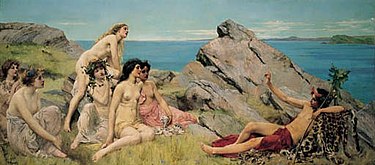
Dionysis and the Maenads from the Dionysian mystery Religions: "Dionysus [...] was the god of the grape harvest, wine making and wine, of ritual madness and ecstasy in Greek mythology. [...] He is a god of epiphany, "the god that comes," and his "foreignness" as an arriving outsider-god may be inherent and essential to his cults. [...]  He is an example of a dying god .

The earliest cult images of Dionysus show a mature male, bearded and robed. He holds a fennel staff, tipped with a pine-cone and known as a thyrsus. Later images show him as a beardless, sensuous, naked or half-naked androgynous youth: the literature describes him as womanly or "man-womanish."[...] His procession (thiasus) is made up of wild female followers (maenads) and bearded satyrs with erect penises. Some are armed with the thyrsus, some dance or play music.[...] This procession is presumed to be the cult model for the human followers of his Dionysian Mysteries. In his Thracian mysteries, he wears the bassaris or fox-skin, symbolizing a new life. Dionysus is represented by city religions as the protector of those who do not belong to conventional society and thus symbolizes everything which is chaotic, dangerous and unexpected, everything which escapes human reason and which can only be attributed to the unforeseeable action of the gods.


He was also known as Bacchus[...], the name adopted by the Romans and the frenzy he induces, bakkheia. His thyrsus is sometimes wound with ivy and dripping with honey. It is a beneficent wand but also a weapon, and can be used to destroy those who oppose his cult and the freedoms he represents. He is also the Liberator (Eleutherios), whose wine, music and ecstatic dance frees his followers from self-conscious fear and care, and subverts the oppressive restraints of the powerful. Those who partake of his mysteries are possessed and empowered by the god himself. His cult is also a "cult of the souls"; his maenads feed the dead through blood-offerings, and he acts as a divine communicant between the living and the dead.[...]

The rebirth in both versions of the story is the primary reason why Dionysus was worshipped in mystery religions, as his death and rebirth were events of mystical reverence. This narrative was apparently used in several Greek and Roman cults, and variants of it are found in Callimachus and Nonnus, who refer to this Dionysus with the title Zagreus, and also in several fragmentary poems attributed to Orpheus.

Initiates worshiped him in the Dionysian Mysteries, which were comparable to and linked with the Orphic Mysteries, and may have influenced Gnosticism. Orpheus was said to have invented the Mysteries of Dionysus. " <Source>

Maenads:  "In Greek mythology, maenads were the female followers of Dionysus (Bacchus in the Roman pantheon), the most significant members of the Thiasus, the god's retinue. Maenads travel alone usually through locations, seeking tribute to her god, Dionysus. If tribute is not given, she will leave the location in utter chaos by leaving all inhabitants under their influence which consists of uncontrolled sexual behavior, loss of senses and complete intoxication.[...]

Often the maenads were portrayed as inspired by him into a state of ecstatic frenzy, through a combination of dancing and drunken intoxication. In this state, they have complete control over the human species where they would make them lose all self-control, begin shouting excitedly, engage in uncontrolled sexual behavior, and ritualistically hunt down and tear to pieces animals—and, at least in myth, sometimes men and children—devouring the raw flesh or heart.[...]

 Cultic rites associated with worship of the Greek god of wine, Dionysus (or Bacchus in Roman mythology), were allegedly characterized by maniacal dancing to the sound of loud music and crashing cymbals, in which the revellers, called Bacchantes, whirled, screamed, became drunk and incited one another to greater and greater ecstasy. The goal was to achieve a state of enthusiasm in which the celebrants’ souls were temporarily freed from their earthly bodies and were able to commune with Bacchus/Dionysus and gain a glimpse of and a preparation for what they would someday experience in eternity. The rite climaxed in a performance of frenzied feats of strength and madness, such as uprooting trees, tearing a bull (the symbol of Dionysus) apart with their bare hands, an act called sparagmos, and eating its flesh raw, an act called omophagia. This latter rite was a sacrament akin to communion in which the participants assumed the strength and character of the god by symbolically eating the raw flesh and drinking the blood of his symbolic incarnation. Having symbolically eaten his body and drunk his blood, the celebrants became possessed by Dionysus." <Source>

Orpheus: "Son of Apollo and the Muse Calliope, Orpheus was a wonderful musician from Thrace who was married to the beautiful Eurydice. He played the lyre and sang so well that the wild animals were tamed and the rivers stopped to listen. [...]

The most famous story about Orpheus is about his wife's death. Eurydice was bit by a snake and descended into Hades. Orpheus then followed her to the kingdom of death, and managed to soften Hades heart with his beautiful music. Hades agreed to let Eurydice go, if Orpheus promised not to look at her until they had reached daylight. When they were almost there, Orpheus thought he could no longer hear his wife's footsteps, and looked back, only to see the screaming Eurydice being pulled back into the underworld.
Shattered by grief, Orpheus wandered the forests of Thrace, singing his wife's lament, and was attacked by the maenads (Dionysus orgiastic women) who tore him to pieces. His singing head floated down the river, and all was lost. Eventually the head floated ashore on Lesbos, and that's how the island became the centre of poetry.

Orpheus was also one of the Argonauts in Jason's expedition for the Golden Fleece. He manage to save the crew from the terrible Sirens by singing more beautifully than them.[...]

One of the great mystery-cults of Ancient Greece was the Orphic one, where its followers believed in purification and reincarnation. They worshipped Dionysus-Zagreus, and thought humans consisted of equal portions of good and evil. They saw the soul as immortal and that one would either live in bliss or torment after death depending on one's acts on earth. For this reason, they thought it very important to lead an ascetic life with many cleansing rituals as well as not eating meat or sacrificing animals. This cult was to become popular in the south of Italy as well." <Source>


"Orpheus was famous for two things - he revealed the ways of initiation, and he taught men to abstain from killing.[...]

Orpheus first appears in Greek art and literature about 540 [BC]. . . . From the first he was associated with the . . . discontinuance of human sacrifice. . . . People with a sense of sin resorted to self-employed practitioners called 'Orphic initiators'. . . . Certainly they did not preach 'pay me and do as you like'; on the contrary, the severer Orphic doctrines taught (not always consistently as there was no Orphic church) respect for all life, with its corollary, vegetarianism, and sexual abstinence. The movement . . . remained . . . far into Christian times." <source>

And in cultural relevancy, we have an exhibit A: "Carolee Schneemann [...] is an American visual artist, known for her discourses on the body, sexuality and gender. [...] Schneemann's works have been associated with a variety of art classifications including Fluxus, Neo-Dada, the Beat Generation, and happenings.[...]

[Film] The 1964 piece Meat Joy revolved around eight partially nude figures dancing and playing with various objects and substances including wet paint, sausage, raw fish, scraps of paper, and raw chickens. It was first performed in Paris and was later filmed and photographed as performed by her Kinetic Theater group at Judson Memorial Church. She described the piece as an "erotic rite" and an indulgent Dionysian "celebration of flesh as material."Meat Joy is similar to the art form happenings in that they both use improvisation and focused on conception, rather than execution." <Source> 


"Meat Joy" is super weird. Watch at your own risk, Lol. 

Friday, February 8, 2013

Legend: Hippo

Whoops! I got a little out-of-alphabetical-order! Permit me to take one small step back...we need to cover the Hippo!

 Please see the Introduction To Rabbit Hole Legend A-Z post for information about sources and purpose

Hippo: Mainly seen on the Cover of the Magical Mystery Tour, and in the movie, itself. It's a source of great mystery as to who was in the walrus costume, and who was in the other costumes, as covered by another blogger at Wizards, Buses and the Physiodelic Church. There is a ton of speculation around what the Walrus symbolizes, and that leads to wondering what the other animals symbolize, as well (See by post on Birds to learn more about the Parrot, and the up-coming posts about the Hare and Walrus). 

""The Hippo has had a very bad press when it comes to its symbolic significance.

It was generally believed that the creature generally preferred to mate with its own mother, while the Egyptians gave one of their evil deities, Typhon, the head of a hippopotamus. Generally, the animal is felt to be a cowardly and irreligious character." (ISS)

""The hippopotamus symbolizes brute animal strength in the Book of Job,  where it appears under the name of Behemoth, a land creature corresponding to the Leviathan of the deeps. Both appear as awesome symbols of forces that illustrate the puny strength of humankind and its need for divine help.

In reverse symbolism, the Egyptian hippopotamus goddess Tawaret is depicted as an emblem of protective strength." (1,001S)

"A red hippo represented the Ancient Egyptian god Set; the thigh is the 'phallic leg of set' symbolic of virility. Set's consort Tawaret was also seen as part hippo and was a goddess of protection in pregnancy and childbirth, because ancient Egyptians recognized the protective nature of a female hippopotamus toward her young. The Ijo people wore masks of aquatic animals like the hippo when practicing their water spirit cults." <Source>

"The Hippos wisdom includes power, emotional depth, creation, imagination, healing, proper use of aggression, ability to move gracefully through emotions, protection of family, mother-fury when needed, birth of new ideas, lucid dreaming, spirit contact.

The hippopotamus is sacred in both Egyptian and African traditions. Its name means ‘Water Horse’, and it spends nearly all day in the water, and when not in water obviously on land. This is the ancient realm of birth, power, creation, imagination, and healing." <Source>

"The Hippopotamus symbolizes both fertility and destruction.[...] Pregnant Egyptian women depended on the hybrid, but largely hippopotamus goddess Taweret for protection and Amenti, "the bringer forth of waters" was one of the several Egyptian aspects of The Great Goddess. The male hippo, by contrast, because it frequently did damage to crops was a manifestation of inimical forces in the world and was linked to the evil Seth." <Source>

Thursday, February 7, 2013

Legend: Horse

Please see the Introduction To Rabbit Hole Legend A-Z post for information about sources and purpose

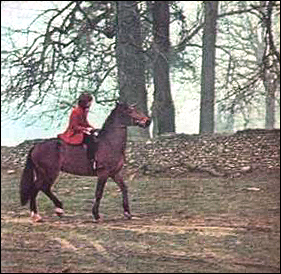
Horse (Dark Horse / Pony): (Also see entry for Night) Images relating to horses come from the Beatles song, I Dig a Pony, George Harrison's song and Album, Dark Horse, and the scene in "Penny Lane" where the Beatles ride horses around Liverpool.

 "[...] The horse belongs to the Sun and the element of fire. Horses proudly draw the chariot of the Sun God. At the same time the horse also belongs to the moon and the element of water, since it carried on its back the God of Oceans, too. [...] In Greece there is a sacred well, called Hippocrene (the Horse's Well), which is shaped like a horseshoe and is dedicated to the muses. Pegasus, the Winged horse, was said to have created this particular sacred well.

The horse symbolizes life and death, darkness and light, good and evil, depending on the context in which it is seen. As well as being a bringer of life, it is also a psychopomp, a creature that guides dead souls on the journey to the next life. As well as having spiritual significance, like the dog with which it shares many characteristics, the horse is valuable in purely practical terms, too. It represents power and wealth, since having a horse- or many horses- confers superiority on the owner, not only in terms of monetary value but in the distances he is able to cover and the speeds at which he can travel. This leads to another aspect of the horse- it is a symbol of freedom. Despite the fact that it can be trained the horse is not inferior to man bit is his equal.

The color of a horse, too carries great significance. Where a white horse appears, it is a symbol of virginal, the spiritual, and the godly. The Buddha, for example, chose to ride a white horse. The Virgin Queen, Elizabeth I, is depicted on a white palfrey. The black horse, conversely often symbolizes death and the dark forces. A golden horse is emblematic of the sun and solar deities.

[...] A mare generally leads herds of horses, and the Horse Goddesses include Epona, the mother-Goddess of the ancient Britons, and Rhiannon. The sacred status of horses meant that the sacrifice of such creatures was a rare and profound event, and even today, there is repugnance among many people at the thought of eating horseflesh; not eating an animal is a sure sign that it is regarded as sacred." (ISS)

"All of these heady aspects of valor were associated with the Horse in Celt animal symbolism. In fact, so much so, the Celts hailed the Horse as the beast belonging to the sun god, and assigned it a place with the goddess Epona (see Celtic Gods & Goddesses for more information on Epona).[...]

In Hindu Brihadaranyaka, the Horse is linked to Varuna and as such, is equated to the cosmos. Additionally, a white horse is believed to be the last incarnation of Vishnu.
                                                                                                            Buddha is said to have left this physical plane riding a white horse. Also in Buddhism a winged horse is often depicted carrying the Book of Law.[...]


Black Horse: Mystery, death, night, secret, messenger of esoteric knowledge
White Horse: Light, sun, day, vitality, illumination, resurrection, messenger of birth" <Source>

"A dark horse is a little-known person or thing that emerges to prominence, especially in a competition of some sort or a contestant that seems unlikely to succeed." <Source>

                             "I Dig a Pony" (I Dig Epona?) from the rooftop concert starts at 3:47


Legend: Honey

Please see the Introduction To Rabbit Hole Legend A-Z post for information about sources and purpose

Honey: Songs include A Taste of Honey, Honey Don't, Honey Pie, Wild Honey Pie ALSO- Paul McCartney's Honey Hush, John Lennon's Album Milk and Honey, lyrics from his song, One Day (At a Time) {Cause you're the honey and I'm the bee}, Clean Up Time {Making bread and honey}, George Harrison's song, She's My Baby {She pours herself a drink. Says, "honey, honey, honey ain't no time to think"}, and Ringo Starr's song You Belong to Me {"oh, i will, honey"}- which I think is a hilarious rejoinder to, "Honey Don't. 


"Legislation requires that all packaged food carry a "best before" date,  but this seems to be particularly unnecessary in the case of honey, since jars of the stuff found in the tombs of Egyptian kings from several thousand years ago have proved to e perfectly edible even now. It could well be because honey is so long lasting, and because it is used as a preservative, that it is a symbol of immortality and used in funeral rites. [...]

The sweetness of honey is believed to confer gifts of learning and poetry. We'll never know if the story that Pythagoras existed on honey alone is true, but the fact that the rumor exists is in accord with his God-like status. [...]

Honey is said to be an aphrodisiac and to encourage fertility and virility, wealth and abundance, and is a symbol of the Sun, partly because of the flowers from which its made but also because of its color." (ISS)

" A basic foodstuff, but which can also be a drink - like milk with which it is often associated -, honey is a symbol of richness and sweetness in all traditions. In the sacred texts of East and West, milk and honey flow like a stream through the promised land. The Celtic traditions celebrate mead as an immortal beverage. In Greek mythology, in which honey is the drink of the gods of Olympus, it is the symbol of knowledge, learning and wisdom , it is a food reserved for the elect, the initiated, and to exceptional people in this world and the next. Greek tradition claims that Pythagoras ate nothing but honey throughout his entire life.


All the great prophets refer to honey in the Scriptures. Speech is honey, it represents softness, justice, virtue and divine goodness. The Koran uses holy terms to talk of bees and honey :"Honey is the first blessing that God gave the earth". Virgil calls honey the celestial gift of the dew, dew itself being a symbol of initiation. Honey even designates supreme bliss and the state of Nirvana. Symbol of all sweetness, the honey of knowledge creates the happiness of mankind.

The perfection of honey makes it a major element in many religions rituals. For the Egyptians, honey was the tears of the god Râ and was a part of all the religious offerings in pharaonic Egypt. In Islam, according to the Prophet, it restores sight, preserves health and resuscitates the dead. For the American Indians, it plays a great part in ceremonies and the rites of initiation and purification. A source of inspiration, honey gave Pindar the gift of poetry and Pythagoras the gift of science.

In modern psychoanalytical thinking, honey symbolizes the "higher self" , the ultimate consequence of work on one's inner self. As the result of the transmutation of ephemeral pollen into a delicious food of immortality, honey symbolizes the transformation by initiation, the conversion of the soul, and the complete integration of the person." <Source>

"Bees were called by the Greeks and Romans the Birds of the Muses. The golden bees were supposed to have gathered honey for the poets on thyme-covered Mount Hymettus to sweeten their verses.[...]

Hindu poetry is literally drenched in honey. Madhukara (honeyborn) had three meanings: bee, lover and moon. There are many romantic Hindu tales associated with honey. [...]

In Hindu mythology all delightful endowments were symbolized by honey. When mem-sahib (woman) was forged by Twasktrie, the Hindu Vulcan, he mixed a little honey in the raw material.[...] According to the Greek and Roman literature, honey possessed the magic power to confer the genius of poetry and eloquence; in Hindu mythology, even wisdom." <Source>

Legend- Ginkgo (See Acacia)

 Please see the Introduction To Rabbit Hole Legend A-Z post for information about sources and purpose

Ginkgo Biloba: The ginkgo leaves are shown above the heads of the Beatles in a photo-collage in the "Beatles Illustrated Lyrics", along with Strawberries, Roses and  Acacia Leaves 

"The ginkgo, native to China, figures prominently in Asian art as well as the Art Nouveau movement of the late nineteenth century, two fields of interest for the Smithsonian’s Sackler and Freer galleries. Ancient Chinese artists often depicted the Buddha’s Dragon Tree as a ginkgo. Chinese monks brought the ginkgo to Japan, where it was widely planted in temple gardens. In Japanese decorative art, the ginkgo’s distinctive fan-shaped leaf has carried symbolism along with its singular beauty: the ginkgo has been a symbol of longevity (the tree can live for a thousand years) and of a more profound endurance (four ginkgos survived the blast at Hiroshima and are still growing today)."  <Source>

"Immortality is also symbolized in China by the Ginkgo, believed to be the oldest of all tree species to have survived unchanged. It was also grown around temples for this reason." (1,001S)

"The ginkgo biloba, or Maidenhair tree, has been known to live for 2,000 years. In the East, it is considered a symbol of longevity, hope, resilience and peace. The tree's delicate fan-shaped leaves have been prized for their beauty, copied by artists and heralded in literature." <Source>

"Ginkgo is believed to have nootropic properties, and is mainly used as memory and concentration enhancer, and antivertigo agent." <Source>

Legend: Flowers (Carnation, Lily, Lotus, Marigold, Rose, Sunflower)

Please see the Introduction To Rabbit Hole Legend A-Z post for information about sources and purpose

Flowers: Flowers are another common theme for the Beatles, from Paul McCartney's albums, "Flowers in the Dirt" and "Red Rose Speedway" and his enigmatic "L.I.L.Y", to the sunflower image in Blue Jay Way and in Free as a Bird. The most intriguing flower image, though has to the the odd presence of (and ridiculous explanations for the presence of..) the black carnation on Paul's lapel in Your Mother Should Know.

{Carnation: In the movie, Magical Mystery Tour, the end segment involves a song-and-dance number called, Your Mother Should Know. In this, the Beatles are seen wearing white tuxedos and all but Paul wear a red carnation in the lapel. Paul has a black carnation...have you ever seen a black carnation? The explanation for this generally given has been that they ran out of red carnations, and only had black ones lying around, so he used that. This is despite the fact that red carnations can clearly be seen in the bouquet in his hand. He is the only one carrying flowers. Again...why did they just have black carnations lying around? You have to go through a lot of expense and effort to acquire black carnations....
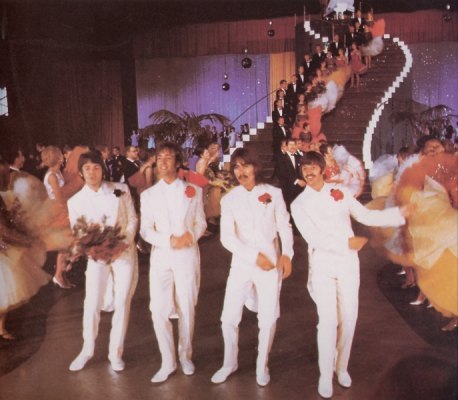
"(Red) My heart aches for you, admiration." (CESS)

"For the most part, carnations express love, fascination, and distinction, though there are many variations dependent on colour. [...] Purple carnations indicate capriciousness. In France, it is a traditional funeral flower, given in condolence for the death of a loved one. In France and Francophone cultures, carnations symbolize misfortune and bad luck. Pink carnations have the most symbolic and historical significance. According to a Christian legend, carnations first appeared on Earth as Jesus carried the Cross. The Virgin Mary shed tears at Jesus' plight, and carnations sprang up from where her tears fell. Thus the pink carnation became the symbol of a mother's undying love. [...]

Some scholars believe that the name "carnation" comes from "coronation" or "corone" (flower garlands), as it was one of the flowers used in Greek ceremonial crowns. Others think the name stems from the Latin "caro" (genitive "carnis") (flesh), which refers to the original colour of the flower, or incarnatio (incarnation), which refers to the incarnation of God made flesh." <Follow link to Source>

"[Red Carnations] Their color means love, pure gratifying love. Light red carnations stand for respect and admiration while deep red, scarlet carnations have a deeper meaning, a meaning of desire and passionate love. They are used in fraternities as a symbol of loyalty and survival and they became, in 1904, the official state flower of Ohio.

Red inspires beauty, heat, strength – red is the color of the heart, and mixed up in the blooms of the carnations, it can only express one feeling – love.<Follow Link to Source>

" If you are invited to a German's house, bring a gift such as chocolates or flowers. [...] Do not give carnations as they symbolize mourning. Do not give lilies or chrysanthemums as they are used at funerals.

 Some older French retail old-style prohibitions against receiving certain flowers: White Lilies or Chrysanthemums as they are used at funerals; Red Carnations as they symbolize bad will; any white flowers as they are used at weddings." <Source>

"Black carnations are filled with mystery. They are often associated with negative things, but even though they seem dark and scary, black carnations can be quite elegant and fancy.
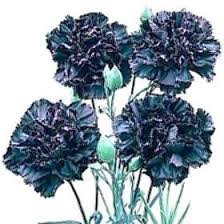
Black carnations are not naturally obtained flowers, they do not exist in nature as such. They are dyed or genetically modified, just like blue flowers.[...]

 Black carnations are obtained by using genetic engineering and hybridization techniques. The Australian company Florigene obtained black carnations by taking the blue pigment from the genes of a petunia and insert it in the DNA of a deep red carnation.[...]

 Black carnations are quite rare and avoided mostly because they symbolize mourning and, therefore, death. Also, there are a few stories in the folklore in which giving a black carnation to someone means that you want the death of that person." <Follow Link to Source>

Lily: Paul has alluded to "L.I.L.Y." on his Ram album (which means Linda I Love You), by placing a "lily" sign next to him during an interview, and insisting on having Lily plants in his dressing room. Stella McCartney just released a perfume called L.I.L.Y.. I'm also positive I remember seeing a lily by a head stone in either "Free as a Bird" or "Yellow Submarine", ...but I can't find the image at the moment.

 "along with the rose and the lotus, the lily comprises a sacred trinity of the most important flower symbols in the world.

[...]The Angel Gabriel  appeared to Mary carrying a lily, and he flower has always been associated with the Virgin. However, the shape of the lily's petals ad its phallic-looking pistils, standing erect from the center of the flower, means that the flower is a symbol of sexuality and reproduction.[...]

The lily is a symbol of the Goddess, in whatever form she may take, and the Babylonian Goddess Lilith- reputedly the first wife of Adam- who was later demonized by the Christian church, takes her name from the name of the lily or the Lilu (Lotus). The flower is also sacred to Astarte, whose name in parts of Europe is Eostre, which gives us the word, "Easter"; hence the lilies which have become a symbol of a much older association. [...]
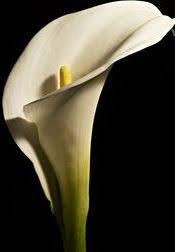
The lily- particularly the calla lily- is also a symbol of resurrection, which is why it is used at funeral and sometimes appears on gravestones." (ISS)

"The flower most commonly associated with funeral services in the popular mind is the lily. Lilies are often interpreted as a symbol of the innocence that has been restored to the soul of the departed. A white stargazer lily symbolizes sympathy and any type of white lily expresses majesty and purity." <Source>}

Marigold: "The King of Marigold was in the kitchen / Cooking breakfast for the Queen / The Queen was in the parlor / Playing piano for the children of the King."

 " The marigold -- genus Tagetes -- is a popular traditional Indian wedding flower, with its bright orange-gold color and ability to stay fresh once cut. Celebrants make them into garlands and use them to decorate religious sites. Marigolds also appear at funerals. First discovered in Central America by the Portuguese in the 16th century, marigolds quickly became popular in India because the flower's color represented honorable people." <Source>
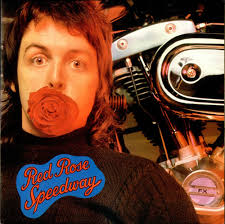

Rose: Most notably referred to by Paul McCartney's "Red Rose Speedway" album..where he is laying with his head on a motorcycle, with a rose "crammed" into his mouth, like a gag-ball or something, or so it seems from his wide, alarmed-looking eyes.

 "[...] The rose is a natural mandala or wheel, the layers of petals describing a perfectly symmetrical circle around its yellow center, itself reminiscent of the Sun.
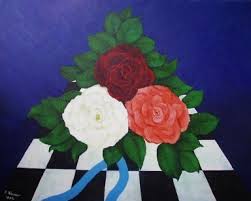
The rose is also a symbol for secrecy, perhaps because of the way the petals hide its center, perhaps for some more obscure reason. To speak of something as being sub rosa- 'under the rose'- means that any information must be kept confidential. Some Masonic lodges and alchemy guilds still conduct meetings with a red rose hanging from the ceiling as a reminder of the private nature of the discussions taking place. There are three roses on the ceremonial apron of the Master Mason, acting as reminders of faith, silence, and secrecy." (ISS)

"Roses were scattered on Roman graves as funerary emblems of mourning to symbolize not only the painful brevity of human life but also the hope of life continuing in a world beyond this" (1,001S)

Lotus: The Lotus comes up in various Beatles images, especially associated with the Maharashi. Also- Tara Brown's car was a Lotus Elan.
"Both the otherworldly appearance of the [lotus] flower and its growing circumstances make it obvious that the flower is somehow very special indeed. It's therefore no surprise that the flower is one of eight auspicious symbols in both Chinese and Tibetan Buddhist iconography.

This sensuous and extraordinary flower, with its perfect petals, rises imperiously from muddy swamps, its head above the dirty water. The symbolism applied by generations of Egyptian, Indian and Chinese sages is obvious. First, the flower arises in complete perfection from the murky primal waters of creation. Next, the flower comes from the darkness into the light, woken by the sun; third, the lotus symbolizes the triumph of spirit over matter and is a metaphor for the journey to enlightenment.

Because the lotus retreats back into the water during the hours of darkness only to rise again above the surface of the water at dawn, the Egyptians saw it as a symbol of death and rebirth.


[...] Lotus has 8 petals, symbolizing the four cardinal directions and the four inter-cardinal directions, as well as the rulers of the eight directions of the universe, or Ashtadikpalas. [...]

In Hindu iconography, the lotus is seen as the base of the earth from which the holy mountains (such as Kailash and Meru) rise. The stalk of the flower is associated with the world axis which rises up through this sacred mountain." (ISS)

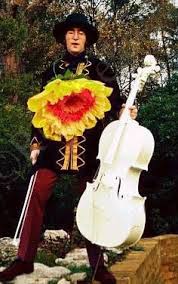
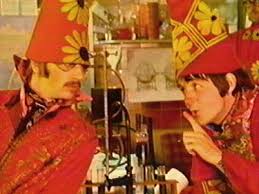
Sun Flower: Referred to in "Free as a Bird", was worn by John in "Blue Jay Way", the Wizards caps in MMT have Sunflowers on them, and Peter Brown stated that George put one on Brian's coffin when he was buried.

  "As its name signifies, the sunflower has close solar associations, not only because of its appearance, but because of its habit of turning its head to follow the sun during its journey across the sky. The sunflower has magical powers, too, and adorned the crowns of Roman Emperors, thereby conferring the ruler with the potent power of the Sun that the flower held within it. The sunflower was later adopted by the Christian Church to denote the saints, prophets, and apostles; as the flower follows the Sun, so the true believer follows God.
Greek legend had it that a nymph Clytie and the Sun God, Helios, were in love. but Helios cast aside poor Clytie for another lover. Clytie died of grief and was transformed into a sunflower, destined to live alone and having to follow the course of her former love. Therefore the sunflower, as a symbol has adopted an aspect of Clytie's personality: the inability to get over some the emotions or to "let go."

The Seed head of the sunflower contains a magical symbol. It shows a perfect example of the golden spiral that has been created naturally. The shape is one of the cornerstones of sacred geometry." (ISS)
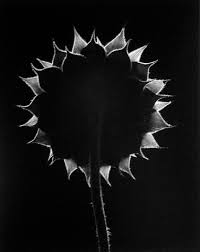
" Sunflowers are symbolic of adoration. Sunflowers turn their heads to the sun, which is the origin of their common name. Sunflowers belong to the genus helianthus, a reference to Helios, the sun god. [...] Sunflowers are native to the Americas and are the state flower of Kansas and the national flower of Russia. Sunflowers bloom from July through September. Sunflowers are traditionally bright yellow with a central disk or reddish brown." <Source>
"Ovid tells the tale of a nymph, Clytie, who pined away for the love of Helios,the Sun, until she was transformed into a flower whose face always turns to follow her love through the sky. This heliotrope was probably not what we call the sunflower, which is named for its appearance rather than its behavior, but the sunflower has long been linked to the unrequited devotion of a lover, or to the longing of the earthbound soul for its heavenly home. A sonnet attributed to Dante laments the disdain of his mistress: ‘‘Nor did she who turns to see the sun / and changed, preserves her unchanged love, /ever have as bitter fate as I’. Blake’s evocative little poem ‘‘Ah! Sun-flower’’ takes the flower, ‘‘weary of time, / Who countes the steps of the Sun,’’ as an emblem of ‘‘the Youth pined away with desire’’and ‘‘the pale Virgin shrouded with snow,’’ who arise from their graves. Blake may have been prompted by an account of the neo-Platonic philosopher Proclus, who cites the heliotrope as a symbol of souls who long for spiritual illumination. The same source seems to have led Bronson Alcott to choose the name The Dial (i.e., sundial) for the journal of the Transcendentalists." <Source>
<Interesting stuff here about Sunflowers and Michael Jackson> }